
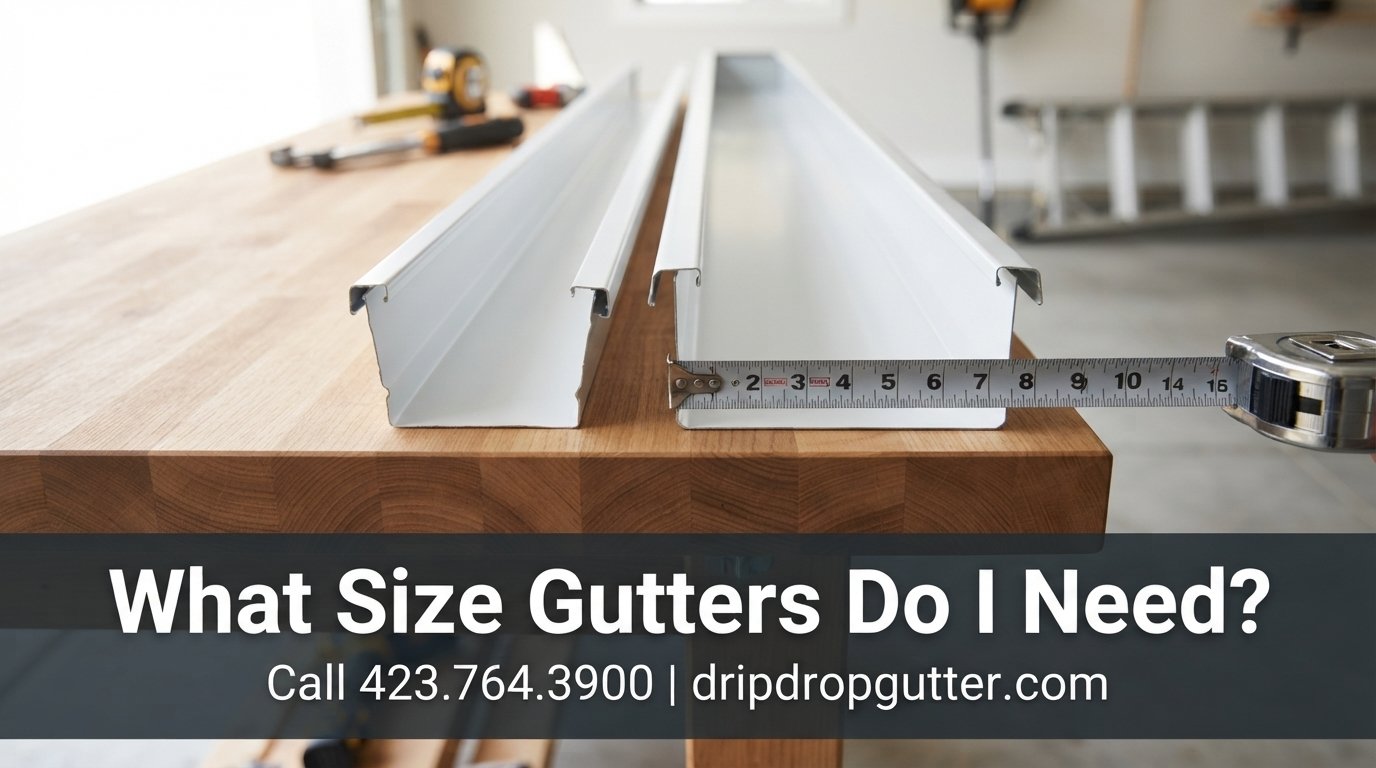
What size gutters do I need? Most homes do fine with standard 5-inch gutters, but larger roofs, steep pitches, metal roofing, or heavy local rain often call for 6-inch gutters instead, since they hold about 40 to 50 percent more water. In East Tennessee, where we see over 40 inches of rain a year and plenty of steep-pitched roofs, that difference matters more than it does in drier parts of the country. Below, Drip Drop Gutter breaks down the key factors that determine your gutter size, so you know what to ask for before you get a quote.
5-Inch Gutters: What They Handle
Five-inch K-style gutters are the standard choice for most residential roofs. They work well on low to moderate roof slopes with light to moderate rainfall, and they pair with standard 2×3-inch downspouts. For a typical single-story or moderately pitched two-story home, 5-inch gutters usually handle the water just fine.
As a rough guide, 5-inch gutters can manage a roof drainage area up to around 5,500 square feet before they start to struggle in heavy rain. If your home falls under that range and has a fairly standard roof pitch, 5-inch is likely a safe starting point.
6-Inch Gutters: What They Handle
Six-inch gutters hold significantly more water than 5-inch gutters, which makes them the better choice for steep roof pitches (8/12 grade or steeper), metal roofs, larger homes, or areas that see frequent heavy downpours. They pair with larger 3×4-inch downspouts, which move water away faster during a hard storm.
If your roof area runs from roughly 5,500 up to 7,900 square feet, or if any of the factors above apply to your home, 6-inch gutters are usually worth the upgrade. The extra capacity costs a little more upfront, but it prevents the overflow and water damage that come with a system that cannot keep up.
Our gutter installation team can measure your roof and confirm the right size before any work begins.
Key Factors That Determine Your Gutter Size
A few specific details about your home decide which size actually fits, beyond just square footage.
- Roof size and pitch: Steeper and larger roofs send water down much faster, which means the gutter needs extra width to avoid overflow. A gently sloped roof puts less strain on a standard 5-inch system.
- Local rainfall: Homes in high-rainfall areas need more capacity, regardless of roof size. Our region’s rainfall totals push many East Tennessee homes toward 6-inch, even when the roof itself would technically qualify for 5-inch elsewhere.
- Downspouts: The downspout size and count control how fast water actually drains. Larger or more frequent downspouts can sometimes let a 5-inch system keep up where it otherwise would not.
- Roof material: Metal roofs shed water faster than asphalt shingles, which increases the volume hitting your gutters during a storm and often pushes homes toward the larger size.
How to Calculate Your Roof’s Drainage Area
You do not need an engineer to get a rough estimate. Measure the length and width of each roof plane that drains toward a given gutter run, multiply them for the square footage, and add the sections together for your total drainage area. Steeper roofs technically shed more water per square foot than the same footprint on a flatter roof, so a steep pitch pushes the effective number higher than the raw measurement suggests.
This calculation gives you a starting point, but roof valleys, multiple stories, and uneven pitches can all shift the real number. A quick on-site measurement is always more accurate than a DIY estimate, especially before committing to a size.
Signs Your Current Gutters Are the Wrong Size
If your home already has gutters, a few signs point to undersized capacity rather than a clog or installation issue. Water spilling over the top during heavy rain, even right after cleaning, often means the gutters simply cannot move water fast enough. Our guide on why gutters overflow covers the other common causes if you want to rule those out first.
Frequent overflow concentrated near roof valleys or areas with a lot of roof surface draining into one run is another sign the gutter or downspout size is not matching the water volume in that spot.
Get a Free Gutter Sizing Estimate
Gutter Sizing in East Tennessee & Southwest Virginia
Our region’s weather changes the math a little compared to national averages. With rainfall regularly exceeding 40 inches a year and a large number of steep-pitched roofs across the Tri-Cities, we install 6-inch gutters more often here than a generic national guide would suggest. Homes in Johnson City, Kingsport, Bristol, and Bluff City with metal roofing or two-story construction are especially good candidates for the larger size.
At Drip Drop Gutter, we have measured and sized gutters across East Tennessee and Southwest Virginia for over 39 years, so we already know which neighborhoods and roof types tend to need the extra capacity.
What Size Gutters Do I Need FAQs
Do I need 5 or 6 inch gutters?
Most homes with a standard roof pitch and moderate rainfall do fine with 5-inch gutters. Steep roofs, metal roofing, larger homes, or heavy local rain, like we see in East Tennessee, usually call for 6-inch gutters instead.
What is the rule of thumb for gutter size?
A common rule of thumb is that 5-inch gutters handle roof drainage areas up to about 5,500 square feet, while 6-inch gutters handle up to around 7,900 square feet. Roof pitch, material, and local rainfall can shift these numbers in either direction.
Are 6-inch gutters better than 7-inch gutters?
For most residential homes, 6-inch gutters provide enough capacity without the added cost and less common parts that come with 7-inch systems. Seven-inch gutters are typically reserved for commercial buildings or homes with unusually large roof areas.
What is the most popular gutter size?
Five-inch K-style gutters remain the most common choice for residential homes nationally. In East Tennessee, though, 6-inch gutters are more common than the national average because of our heavier rainfall and steeper roof pitches.
Does gutter size affect installation cost?
Yes. Larger gutters use more material and often need larger downspouts, so 6-inch systems typically cost more than 5-inch. Our gutter installation cost guide breaks down the price ranges by material and size.
Can I just upgrade my downspouts instead of the whole gutter size?
Sometimes. Larger downspouts can help a 5-inch system drain faster, but they will not add capacity to the gutter channel itself. If your gutters overflow during heavy rain even with good downspouts, the gutter size itself is usually the real limit.