
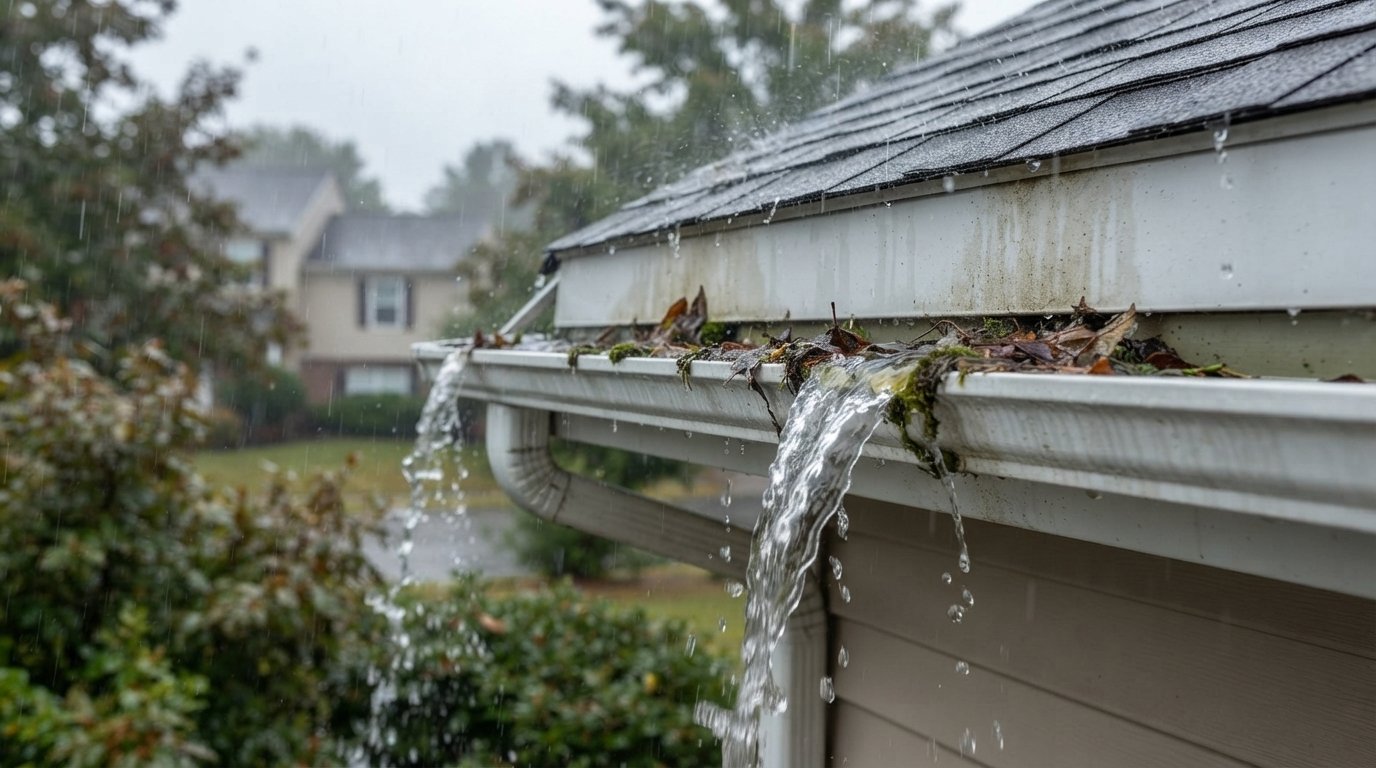
Why are my gutters overflowing? It usually comes down to one of a few causes: clogged debris, an improper slope, gutters that are too small for your roof, or downspouts that cannot keep up with heavy rain. In East Tennessee, where we get over 40 inches of rain a year and many yards sit under heavy pine and cedar cover, overflow problems show up more often than in drier regions. Below, Drip Drop Gutter walks through the most common causes, what each one looks like, and when it is time to call a pro.
The Most Common Cause: Clogged Debris
Clogged gutters are the number one reason gutters overflow, and in our area that usually means leaves, pine needles, and seed pods packed into the channel. Once debris builds up, water has nowhere to go but over the edge.
You can often spot this from the ground. If you see leaves or plant matter spilling over the lip of the gutter during rain, or piled visibly along the top, a clog is the likely culprit. Homes near heavy tree cover in Johnson City and Kingsport tend to see this fastest.
Regular gutter cleaning clears this out before it becomes a bigger problem. If you are unsure how often your home needs it, our gutter maintenance guide breaks down a seasonal schedule for the Tri-Cities.
Improper Slope or Pitch
Gutters need a slight, consistent slope toward the downspouts so water keeps moving instead of sitting still. When the slope is off, even a small amount of rain can pool in one section and spill over before it ever reaches the downspout.
This often happens gradually. Fasteners loosen over time, a section settles unevenly, or the gutter was never pitched correctly during installation. You may notice standing water in the gutter well after rain stops, which is a clear sign the pitch needs adjusting.
Correcting the slope is a repair job, not a cleaning job. Our gutter repair team can re-hang and re-pitch sections so water flows the way it should again.
Undersized Gutters for Your Roof
Some homes simply have gutters that are too small for the amount of water their roof produces. Standard 5-inch gutters work fine for many homes, but larger roofs, steep pitches, or homes with a lot of roof surface draining into one run can overwhelm that capacity during a heavy storm.
This shows up as overflow specifically during hard rain, even when the gutters are clean and properly pitched. If your gutters only overflow in downpours and stay fine otherwise, undersized capacity is worth checking.
Upgrading to a larger gutter size or adding capacity through our gutter installation service solves this permanently, rather than treating the symptoms every storm season.
Sagging or Loose Gutters
Gutters that have pulled away from the fascia, or that sag between hangers, change the pitch of the whole system. Once a section sags, water collects at the low point instead of draining, and the weight of that trapped water often makes the sagging worse over time.
Common signs include visible gaps between the gutter and the roofline, sections that look wavy instead of straight, or hangers that have come loose. Heavy debris sitting in the gutter for a long time can also pull it away from the house.
This is a repair need, not something to patch temporarily. Left alone, sagging sections tend to fail completely, so it is worth addressing early.
Downspout Problems
Even a clean, well-pitched gutter can overflow if the downspouts cannot move water away fast enough. This usually comes down to too few downspouts for the length of gutter, or a downspout that is partially or fully blocked.
As a general rule, one downspout every 35 to 40 linear feet of gutter keeps water moving during most storms. Homes with long gutter runs and only one downspout often see overflow right near the far end, away from the downspout itself.
If you notice overflow concentrated in one area rather than along the whole gutter, check the nearest downspout first. A clog can sit right where the gutter meets the downspout, or much further down in an underground drain line if your downspouts connect to buried piping. If the gutter itself looks clean but water still backs up near one downspout, an underground clog is a common cause homeowners often miss.
To check, disconnect the downspout at the bottom and run a garden hose into it for several minutes. If water backs up instead of draining, the blockage is likely underground rather than in the gutter. Our gutter repair team can clear blockages, add downspouts, or point you to the right fix if the clog is buried below grade.
Roof Valleys and Water Velocity
Not every overflow spot means something is wrong with the gutter itself. Roof valleys, where two roof slopes meet, funnel a large volume of water into one concentrated area during heavy rain. That surge can move faster than the gutter in that spot can handle, causing water to splash over the edge even when the rest of the system drains fine.
This usually shows up as overflow at one specific corner or section, right below a valley, while the rest of the gutter run stays clear. Installing a splash guard at that high-flow corner is often enough to stop water from jumping the gutter during heavy storms, without needing to replace or resize the whole system.
Why Are My Gutters Overflowing During Heavy Rain?
Sometimes the gutters themselves are not the problem. During intense East Tennessee thunderstorms, water can fall faster than any gutter system is designed to handle, which causes brief overflow even on a well-maintained system. The National Weather Service tracks rainfall intensity for our region, and heavy downpours here regularly exceed what a standard residential gutter is built to drain in a short burst.
Winter brings a different version of the same issue. Freeze-thaw cycles can create ice dams that block water from draining, forcing it to back up and spill over the edge, or under the roofline. This is more common on homes with less attic insulation or ventilation.
If overflow only happens during the heaviest storms or cold snaps, it may be a capacity or seasonal issue rather than a defect in your gutters. A local inspection can tell you which it is.
What Overflowing Gutters Can Damage
Overflow is not just a mess. Water spilling over the edge lands right along your foundation, which over time leads to cracking, basement seepage, and soil erosion. It also runs down fascia boards and siding, which causes rot, staining, and paint damage that gets more expensive the longer it sits.
In East Tennessee’s wet climate, standing water near the home creates ideal conditions for mold, especially where siding or trim stays damp for extended periods. Overflow that backs up right under the roofline can also work its way into the roof deck itself, which is often where a roof leak actually starts. Catching overflow early is almost always cheaper than repairing what it damages.
When to Call a Professional
A quick cleaning solves overflow caused by debris, but the other causes need a trained eye. If you are still asking “why are my gutters overflowing” after a thorough cleaning, if you see sagging or gaps at the fascia, or if overflow only happens during heavy storms, a professional inspection finds the real cause instead of guessing.
Drip Drop Gutter has inspected and repaired gutters across East Tennessee and Southwest Virginia for over 39 years, so our crews already know which local conditions, tree cover, roof types, and storm patterns tend to cause overflow in this area.